- 15+ YEARS OF EXPERIENCE
Professional UV Light Installation in Austin, TX
Austin’s trusted UV light installation specialists. Schedule your service today and enjoy cleaner indoor air, reduced airborne contaminants, and a healthier home environment.
- 1000+ Google Reviews
- Certified Technicians
- Same-Day Availability
- 15+ Years of Experience
Austin's Trusted UV Light Installation Experts
If you’ve ever pulled back the panel on your HVAC system’s evaporator coil and seen a dark, fuzzy coating covering the fins — or if you’ve caught that musty, wet-sock smell every time your air conditioner kicks on — you’ve already met the problem that UV-C light was designed to solve.
Mold. Bacteria. Biofilm. Microbial growth that thrives in the dark, damp environment inside your air handler and ductwork. In Austin, where air conditioners run eight months a year and humidity sits heavy from May through October, that microbial growth isn’t an occasional nuisance. It’s a constant, active process that affects your air quality, your system’s efficiency, and your family’s health.
At Supreme Air Austin, we’ve been installing UV-C light systems in Austin homes since 2010. We’ve placed lamps at evaporator coils that were so coated in mold the homeowner thought the fins were black metal. We’ve installed duct-mounted systems in medical offices where infection control isn’t optional. We’ve replaced lamps that have been running silently for years, keeping biological contamination at bay while the homeowners forgot they were even there.
We know which lamp intensities actually work in Austin’s climate. We know where to place them for maximum exposure without restricting airflow. We know the difference between a legitimate UV-C system and the underpowered consumer-grade strips that look impressive but deliver insufficient dosage to neutralize anything.
With 1000+ five-star Google reviews and 15+ years of hands-on experience in Central Texas homes and businesses, we install UV light systems that do what they claim — not gimmicks that glow purple and do little else.
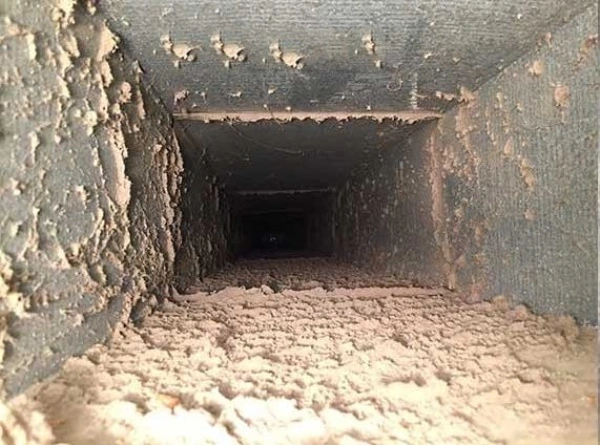
 AFTER
AFTER
 BEFORE
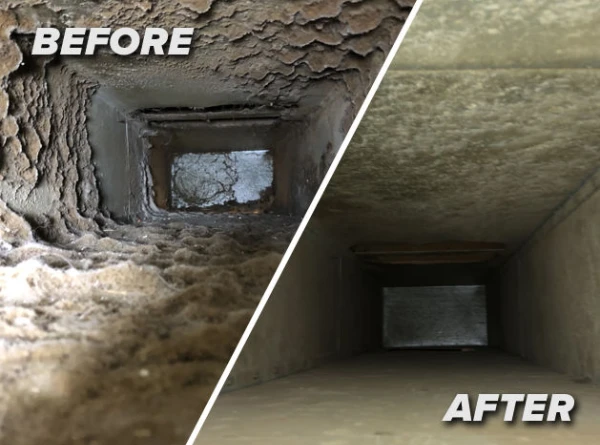
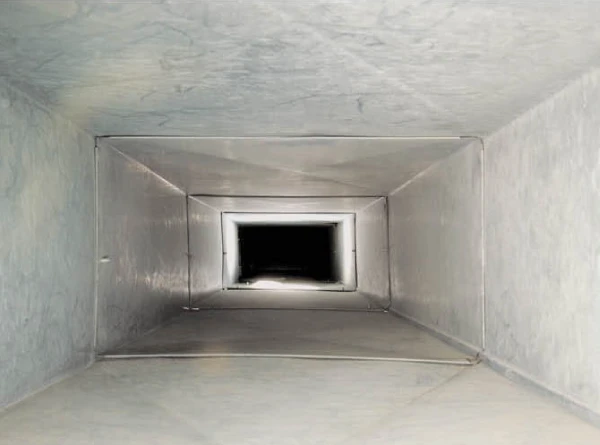 AFTER
AFTER
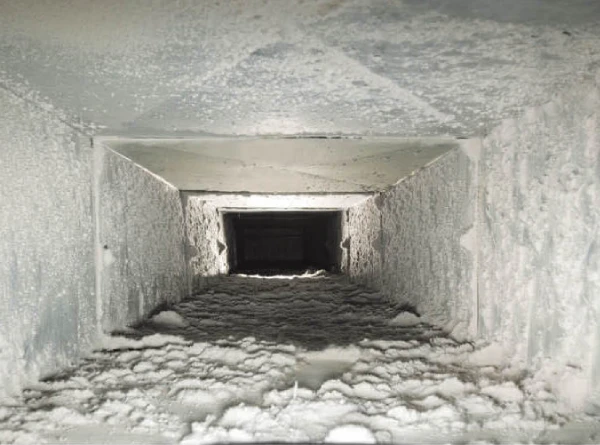 BEFORE
Why Austin Homes Need UV Light Installation
Austin’s climate creates conditions inside HVAC systems that are nearly perfect for biological growth. Here’s what’s actually happening inside your air handler right now:
Constant Moisture at the Evaporator Coil
Your air conditioner's evaporator coil operates at temperatures around 40°F. Warm, humid Austin air passes over those cold fins, and moisture condenses — gallons of it per day during summer. That water drips into a drain pan and (ideally) exits through a condensate line. But the coil itself stays damp for hours after each cooling cycle. The drain pan retains a thin film of water. And in the dark interior of your air handler, that moisture never fully dries.
Long Cooling Seasons Mean Constant Exposure
In cooler climates, the evaporator coil dries out for months during winter. In Austin, your AC runs from April through October, often longer. That means your coil stays wet for eight months straight. There's no off-season for microbial growth here. The colony that starts in May is still thriving in November.
High Humidity Supports Ductwork Mold
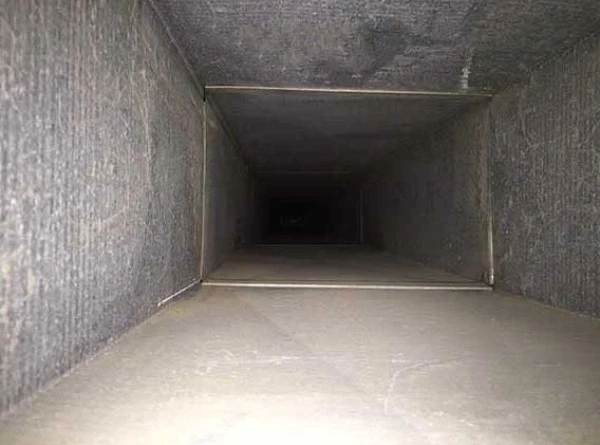
Austin's outdoor humidity averages 60–70% during summer. When your ductwork has any leaks and most duct systems do — that humid air enters the return ducts and mixes with cooled air. The result is condensation inside ductwork, particularly at joints, bends, and low points. Mold growth in ducts is harder to spot than coil mold, but it's equally effective at distributing spores through your home.
Cedar Pollen and Organic Load
Austin's intense pollen seasons — especially Mountain Cedar in winter — deposit enormous amounts of organic material on your coil and in your ducts. Pollen is nutrient-rich. It feeds microbial colonies. A coil that's already damp and dark becomes a buffet when coated in cedar pollen. The biological activity accelerates.
Post-Construction and Renovation Contamination
Austin's growth means construction dust is everywhere. Drywall dust, wood particles, and insulation fibers settle in ductwork and on coils. These particles trap moisture, create surface area for microbial attachment, and provide additional organic material for biological growth.
How UV-C Light Actually Works in Your HVAC System
UV-C light is ultraviolet light in the 200–280 nanometer wavelength range. It’s the same type of UV light that causes sunburn — but contained, directed, and used for a specific purpose inside your HVAC system.
The Science of Germicidal UV
UV-C photons penetrate the cell walls of microorganisms — bacteria, viruses, mold spores, and fungal cells. The energy damages their DNA and RNA, preventing replication. A microorganism that can’t reproduce is effectively neutralized, even if the cell isn’t immediately killed. It can’t form colonies, can’t produce toxins, and can’t trigger allergic responses.
The effectiveness depends on three factors:
- Intensity: The wattage and output of the UV lamp
- Exposure time: How long the microorganism remains within the UV field
- Distance: How close the organism is to the lamp source
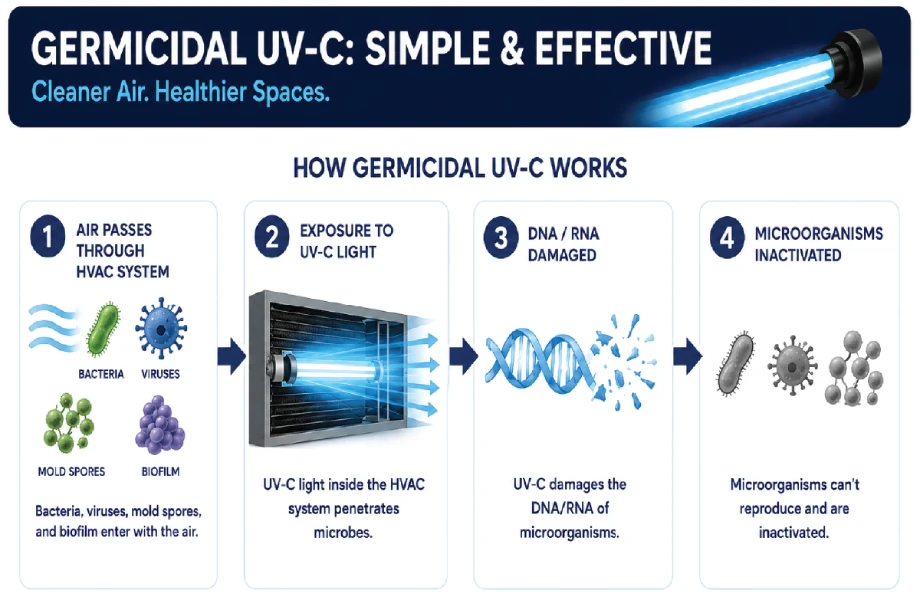
Where UV-C Light Works in Your HVAC System
Evaporator Coil
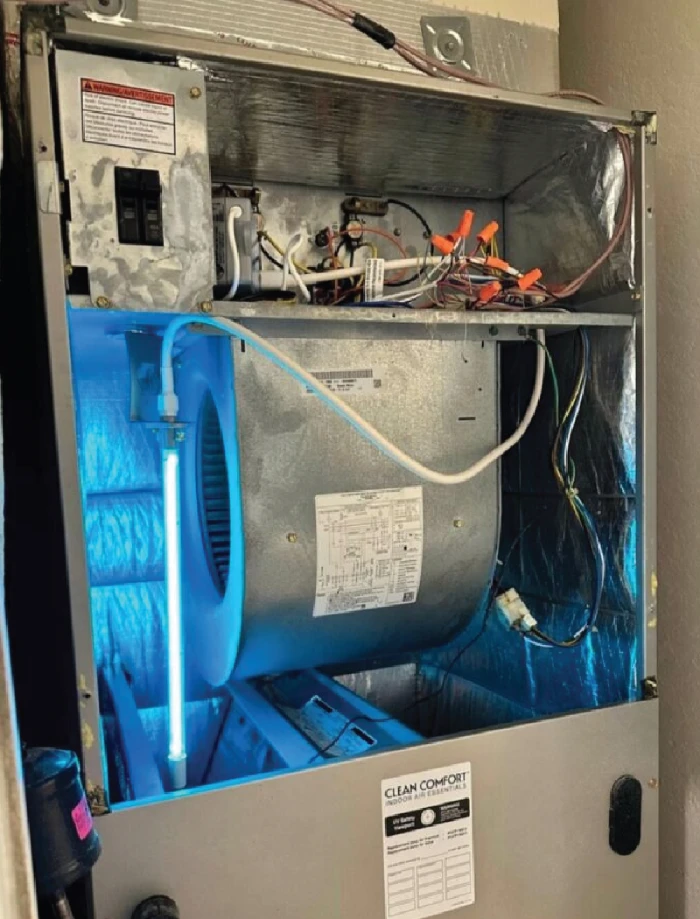
The primary target. A UV lamp mounted facing the coil surface keeps the fins, drain pan, and immediate surrounding area sanitized. The lamp runs continuously, preventing new growth and gradually breaking down existing biofilm.
Return Ductwork
A second lamp placed in the return air stream treats air as it's drawn back to the system. This captures airborne mold spores, bacteria, and viruses before they reach the coil or blower.
Supply Ductwork
Less common for residential, but effective in commercial or medical settings where supply air must be as clean as possible before reaching occupied spaces.
What UV-C Light Does NOT Do
This is important, and we’re honest about it:
UV-C does not filter particles
It doesn't remove dust, pollen, pet dander, or smoke. For particulate, you need filtration — HEPA or high-MERV media.
UV-C does not remove odors directly.
It doesn't remove dust, pollen, pet dander, or smoke. For particulate, you need filtration — HEPA or high-MERV media.
UV-C does not clean dirty ducts
It prevents biological growth on surfaces it's aimed at, but it doesn't remove accumulated dust and debris from ductwork. For that, you need duct cleaning.
UV-C is one tool in a comprehensive indoor air quality strategy — not a magic bullet. We recommend it when biological contamination is the identified problem, and we pair it with other solutions when multiple contaminants are present.
Want to know if UV-C is the right solution for your home? We'll test and assess honestly. Call (512) 277-9782
Types of UV Light Systems We Install
Not all UV systems are equal. We install equipment matched to your specific HVAC configuration and contamination profile.
Coil-Sanitizing UV Systems
These are single-lamp units mounted inside the air handler, positioned to illuminate the evaporator coil and drain pan. They're the most common residential installation and address the primary source of HVAC microbial growth.
Best for: Homes with musty odors, visible mold on coils, frequent drain pan clogs, or allergy symptoms that worsen when the AC runs.
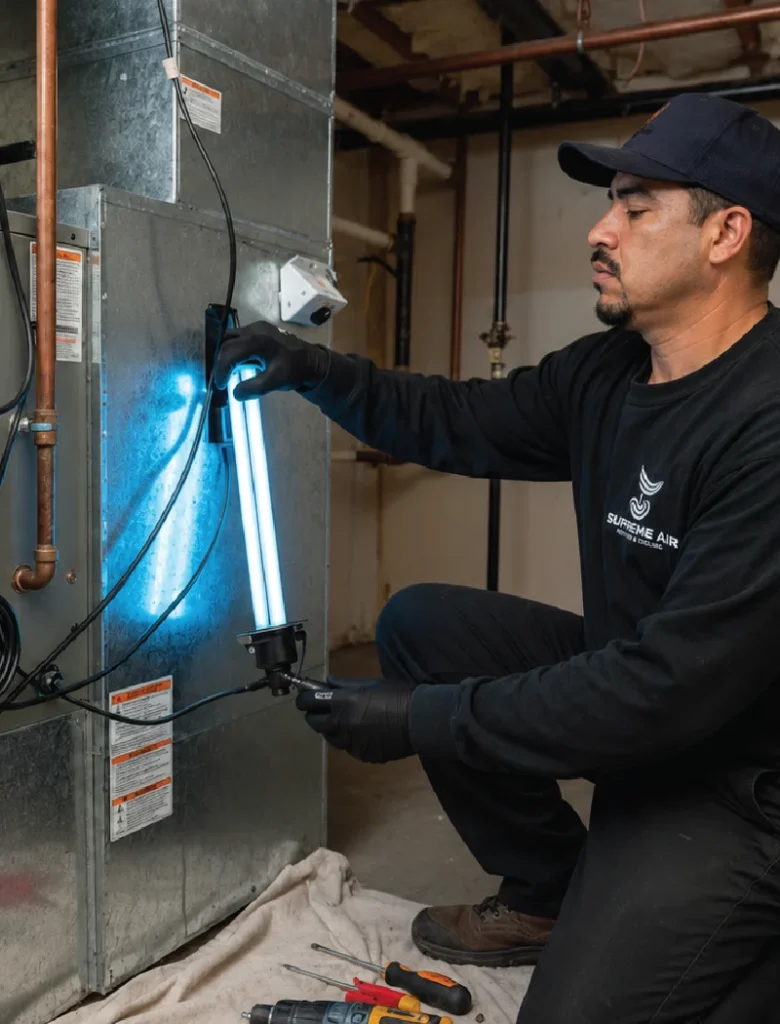
How we install: We mount the lamp bracket on the air handler cabinet or ductwork adjacent to the coil, ensuring the lamp has a clear line of sight to the entire coil surface. We position it so the bulb is accessible for annual replacement without disassembling the unit. We wire it to the system’s 24V control board so it runs whenever the system has power — not just when the blower cycles.
Dual-Lamp UV Systems
These systems place one lamp at the coil and a second lamp in the return ductwork. The coil lamp prevents surface growth; the return lamp treats airborne organisms in the airstream.
Best for: Homes with severe allergy or asthma sufferers, homes with documented mold in ductwork, or homeowners who want comprehensive biological protection.
How we install: We assess your return duct configuration to find the optimal placement for the second lamp — typically 6–10 feet upstream of the air handler, where exposure time is maximized without creating airflow restriction.
High-Output Commercial UV Systems
For commercial buildings, medical offices, and facilities with strict air quality requirements, we install higher-wattage systems with multiple lamps, reflectors to maximize UV distribution, and monitoring systems that track lamp output.
Best for: Medical and dental offices, schools, daycares, commercial buildings with high occupancy, and facilities requiring documented compliance.
In-Duct Air Purification Systems (UV + PCO)
These advanced systems combine UV-C light with a photocatalytic oxidation (PCO) catalyst — typically titanium dioxide. The UV light activates the catalyst, which produces hydroxyl radicals and superoxide ions that break down VOCs, odors, and biological contaminants in the airstream.
Best for: Homes with chemical sensitivity, new construction off-gassing, persistent odors, or homeowners wanting the most comprehensive air treatment available.
Our honest assessment: PCO systems are effective when properly sized and maintained. They’re not necessary for every home. We recommend them when VOCs or odors are a documented problem alongside biological concerns.
Our UV Light Installation Process
UV light installation is electrical work in a wet environment, mounted on equipment that costs thousands of dollars. We don’t treat it lightly.
HVAC System Inspection
We examine your air handler, evaporator coil, drain pan, and ductwork. We look for existing mold, biofilm, moisture issues, and airflow patterns. We photograph the coil condition before installation. If the coil is heavily contaminated, we may recommend cleaning before UV installation — a UV lamp shining on thick biofilm is less effective than one shining on a clean surface.
UV System Sizing and Selection
Based on your system size (tonnage), coil dimensions, duct dimensions, and contamination profile, we select the appropriate lamp wattage and configuration. Undersized lamps are ineffective. Oversized lamps waste money and can create ozone if not properly shielded.
Electrical Integration
We wire the UV system into your HVAC control board or dedicated power source. We use proper gauge wire, secure connections, and conduit where required. We verify that the installation doesn't interfere with existing controls, safety switches, or thermostat operation.
Lamp Placement and Mounting
We position the lamp for maximum coil exposure or optimal duct airflow treatment. We ensure the lamp is secure against vibration, won't contact refrigerant lines or wiring, and is oriented so replacement is straightforward. We shield the lamp so UV light doesn't escape the air handler or duct — UV-C is harmful to eyes and skin.
Documentation and Education
We power the system and verify lamp ignition. We measure UV intensity at the target surface using a UV meter to confirm adequate dosage. We check for ozone production (quality UV-C lamps designed for HVAC use produce negligible ozone; we verify this). We confirm the lamp cycles correctly with system power.
Final Inspection
We provide you with:
- Before-and-after photos of the coil or duct area
- Lamp model and wattage information
- Installation date and recommended replacement date
- Safety information about UV exposure
- Maintenance schedule
Looking for air duct cleaning near me? We serve the entire Austin metro area. Call (512) 277-9782 to check availability in your neighborhood.
Signs Your Austin Home Needs UV Light Installation
Your home and your body will tell you when biological contamination is active in your HVAC system.
- Musty or mildew smell when the AC runs. This is the most common indicator of coil or drain pan mold. The odor is most noticeable when the system first cycles on.
- Visible mold or dark staining on the evaporator coil. If you’ve peeked inside your air handler and seen black, green, or gray coating on the fins, you have active microbial growth.
- Frequent condensate drain clogs. Algae and biofilm in the drain pan clog the line repeatedly. You keep pouring bleach or vinegar down the drain, and it keeps clogging.
- Family members with worsening allergies or asthma, especially when the HVAC runs. If symptoms improve when you leave the house but return when you come back, the system is likely distributing biological contaminants.
- You’ve had water damage or a roof leak that affected ductwork. Moisture in ducts creates mold growth that UV light can prevent from recurring after cleanup.
- Your home is more than 10 years old and has never had the coil cleaned or treated. A decade of Austin humidity has almost certainly allowed biological colonization.
- You run a humidifier or have high indoor humidity. Humid indoor conditions accelerate coil and duct contamination.
- You recently had duct cleaning but the musty smell returned within weeks. The ducts are clean, but the coil is still growing mold and recontaminating the air.
- You have a family member who is immunocompromised. Neutralizing airborne bacteria, viruses, and mold spores reduces infection risk.
UV Light and Austin's Specific Air Quality Challenges
Austin’s unique environment makes UV-C light particularly relevant. Here’s how UV addresses our city’s specific problems:
Cedar Fever and Pollen Season
While UV doesn't filter pollen particles, it neutralizes the mold spores and bacteria that thrive on pollen accumulated in your system. During cedar season, when your HVAC runs constantly and pulls enormous volumes of outdoor air through the system, microbial growth accelerates. UV-C keeps the coil and drain pan from becoming a biological factory that compounds your allergy misery.
Summer Mold Amplification
Austin's combination of 100°F days and 70% humidity creates extreme conditions inside air handlers. The temperature differential between outdoor air and the 40°F coil is massive. Condensation is heavy. UV-C light running continuously during these months prevents the explosive mold growth that would otherwise occur.
Wildfire Smoke Events
When wildfire smoke reaches Austin, PM2.5 levels spike. While UV doesn't remove smoke particles (you need HEPA filtration for that), smoke events often coincide with extended HVAC runtime and closed windows. That extended runtime means the coil stays wet longer and microbial growth accelerates. UV-C protects the system during these high-use periods.
Post-Flood and Storm Recovery
Austin's flash flooding and occasional hurricanes leave homes with water-damaged HVAC systems. After cleanup and drying, UV-C installation prevents mold recurrence in equipment that was previously contaminated.
New Construction Off-Gassing
Austin's building boom means many homeowners are in new or recently renovated homes. The VOCs from new materials can feed certain microbial populations. UV-C, particularly PCO systems, breaks down both the biological organisms and some of the chemical contaminants.
Commercial UV Light Installation in Austin
Businesses and institutions in Austin face the same biological challenges as homes — often at higher concentrations due to occupancy and system complexity.
Medical and Dental Offices
Patient safety demands clean air. Medical offices benefit from UV-C at coils and in return ducts to reduce airborne bacterial and viral loads. We install systems that support infection control protocols and demonstrate commitment to patient wellbeing.
Schools and Daycares
Children are more susceptible to airborne pathogens. UV-C systems in school HVAC reduce absenteeism and create healthier learning environments. We work with facilities managers to install during breaks or after hours.
Restaurants and Food Service
Kitchen humidity and grease affect general HVAC systems. UV-C prevents mold in return ducts and on coils, reducing odors and maintaining air quality for dining areas.
Office Buildings and Coworking Spaces
High occupancy means high bio-burden. UV-C in commercial HVAC systems reduces the microbial load recirculated through shared air systems. This is particularly valuable in post-pandemic workplace environments.
Multi-Unit Properties
Apartment complexes and condos with central HVAC systems benefit from UV-C at the main air handler, protecting all units served by the system.
UV Light Maintenance and Lamp Replacement
UV-C lamps are not install-and-forget devices. They require periodic maintenance to remain effective.
Lamp Lifespan and Degradation
UV-C lamps lose intensity over time, even though they continue to glow. A lamp that looks like it’s working may be producing only 50% of its original UV output after 12 months. At that reduced intensity, it’s no longer delivering the germicidal dose needed to neutralize microorganisms.
Replacement schedule: Annually, without exception. We mark your installation date and contact you when replacement is due.
What We Do During Maintenance
- Remove the old lamp safely (UV bulbs contain mercury and require proper disposal)
- Clean the lamp bracket and reflector surfaces
- Inspect the coil and drain pan for new growth
- Install the new lamp and verify intensity with a UV meter
- Test electrical connections and system integration
- Update your maintenance records
Annual Maintenance Plans
We offer maintenance plans for Austin homeowners who prefer to have us handle lamp replacement on schedule. This ensures your system never runs with a degraded lamp, and it includes a full HVAC inspection during each visit.
Want us to handle maintenance automatically? Call us at (512) 277-9782.
Neighborhoods and Areas We Serve Across Austin
We install UV light systems throughout the greater Austin metro. Our technicians are stationed across Central Texas for responsive scheduling.
Central & South Austin
North & Northwest Austin
East & Northeast Austin
West Austin & Hill Country
South & Southwest Austin
Cedar Park & Leander
Fast-growing suburbs with new HVAC systems that benefit from proactive UV installation.
Historic and new developments with varying HVAC configurations.
Frequently Asked Questions About UV Light Installation in Austin
1. How much does UV light installation cost in Austin?
For a typical Austin home, professional UV-C light installation ranges from $400 to $1,200 depending on the system type and your HVAC configuration.
- Single coil-sanitizing lamp: $400–$700
- Dual-lamp system (coil + duct): $700–$1,000
- High-output commercial systems: $1,000–$2,500+
- UV + PCO combination systems: $1,200–$2,000
2. Is UV light installation worth it?
For Austin homes with active microbial growth, persistent musty odors, or allergy sufferers, yes. UV-C is the most effective method for preventing biological colonization on coils and in drain pans. It’s not necessary for every home — if your coil is clean and you have no air quality symptoms, filtration may be sufficient. We assess honestly and don’t sell you what you don’t need.
3. How long does UV light installation take?
Most residential installations take 1–2 hours. Dual-lamp systems or complex commercial configurations may take longer. We’ll give you a clear time estimate before we start.
4. Is UV-C light safe?
Properly installed UV-C systems in ductwork and air handlers are safe — the UV light is contained within the equipment and shielded from exposure. We never install systems that allow UV light to escape into occupied spaces. The lamps we use are designed for HVAC applications and produce negligible ozone.
You should never look directly at a UV lamp. We install them in positions where accidental exposure is unlikely, and we provide safety information with every installation.
5. Will UV light kill mold in my ducts?
UV-C prevents mold growth on surfaces it illuminates. It does not remove existing mold from duct walls or kill mold spores that pass through the airstream too quickly for adequate exposure. If you have active mold in ductwork, you need professional duct cleaning and remediation first. UV-C then prevents recurrence.
6. Does UV light remove odors?
UV-C neutralizes the biological organisms that cause some musty odors. It does not remove chemical odors, smoke, or VOCs. For odor removal, we recommend activated carbon filtration or PCO systems that combine UV with catalytic oxidation.
7. How often do UV lamps need replacement?
Annually. UV-C lamps degrade in intensity even though they continue to emit visible light. After 12 months, most lamps produce insufficient germicidal dosage to be effective. We recommend calendar-based replacement, not waiting for visible failure.
8. Can I install a UV light myself?
We don’t recommend it. UV installation involves electrical work in a wet environment, proper placement for exposure effectiveness, and safety shielding to prevent UV escape. Incorrect installation can damage your HVAC system, create electrical hazards, or expose occupants to harmful UV radiation. Our technicians are trained and insured for this work.
9. Will UV light help with my cedar allergies?
Indirectly. UV doesn’t filter cedar pollen. But cedar pollen that enters your system feeds microbial growth on the coil, which then distributes mold spores and musty odors. UV prevents that secondary contamination. For direct pollen filtration, pair UV with a high-MERV or HEPA filter.
10. Can UV light run all the time?
Yes, and it should. We wire UV systems to run continuously whenever the HVAC system has power, not just when the blower cycles. This ensures the coil and drain pan stay sanitized even between cooling cycles. The electrical consumption is minimal, typically 15–30 watts, comparable to a LED light bulb.
11. Does UV light produce ozone?
Quality UV-C lamps designed for HVAC use produce negligible ozone (well below EPA safety thresholds). Cheap, poorly designed lamps or lamps operating at the wrong wavelength can produce ozone. We only install lamps from reputable manufacturers with ozone testing documentation.
12. Will UV light damage my coil or ductwork?
No. UV-C light affects organic material — mold, bacteria, biofilm. It does not damage metal coils, aluminum fins, or galvanized ductwork. Over many years, UV exposure can slightly degrade certain plastics or rubber gaskets in the air handler. We inspect these components during annual maintenance.
13. Can UV light replace duct cleaning?
No. UV prevents biological growth on surfaces it reaches. It does not remove accumulated dust, debris, construction particulate, or existing mold from duct walls. Duct cleaning removes the physical contamination. UV prevents it from returning. They complement each other.
14. Do you offer same-day UV installation?
For standard single-lamp systems, we often can install same-day or next-day based on inventory and scheduling. Custom or dual-lamp systems may require a return visit. Call (512) 277-9782 for current availability.
15. Can UV light help with COVID-19 or other viruses?
UV-C is proven effective at neutralizing many viruses, including coronaviruses, when exposure time and intensity are adequate. However, UV-C in residential HVAC systems is not a guaranteed COVID-19 prevention measure. It reduces airborne viral loads as part of a comprehensive strategy that includes filtration, ventilation, and source control. We don’t make medical claims — we install systems that improve overall biological air quality.
16. What's the difference between UV-A, UV-B, and UV-C?
- UV-A (315–400 nm): Reaches Earth’s surface, causes skin aging, used in tanning. Not germicidal.
- UV-B (280–315 nm): Partially blocked by ozone, causes sunburn, some germicidal effect. Not used in HVAC.
- UV-C (200–280 nm): Almost entirely blocked by Earth’s atmosphere. Highly germicidal. This is what we install.
17. Will UV light increase my electric bill?
Minimally. A typical UV lamp draws 15–30 watts — less than most light bulbs. Running continuously, that’s roughly $2–$4 per month. The energy savings from a cleaner, more efficient coil typically offset this cost several times over.
18. Can I see the UV lamp working?
You shouldn’t look directly at it — UV-C damages eyes. But we can show you the lamp’s blue glow through a viewport or with a UV detection card during installation. We also verify intensity with a UV meter and share the readings with you.
About Supreme Air Austin UV Services
Supreme Air Austin is a locally-owned company serving Austin, Texas and surrounding communities since 2010. We started in air duct cleaning, expanded into attic insulation and air purification, and added UV light installation because our customers kept discovering that their “clean” ducts were being recontaminated by moldy coils and drain pans.
We’re not a franchise. We’re not a call center. We’re Austin locals who understand that Austin’s eight-month cooling season and heavy humidity create biological conditions inside HVAC systems that milder climates simply don’t face.
With 1000+ five-star Google reviews and 15+ years of experience, we’ve installed UV systems in homes and businesses from Travis Heights to Cedar Park, from Georgetown to Kyle. Every installation is properly sized, safely wired, and tested for effective dosage.
Every UV installation includes:
- Properly sized lamp selection based on your system
- Professional electrical integration
- Shielded, safe installation with no UV escape
- Intensity verification with UV meter
- Annual replacement reminders and maintenance plans
- Honest assessment of whether UV is right for your specific situation