
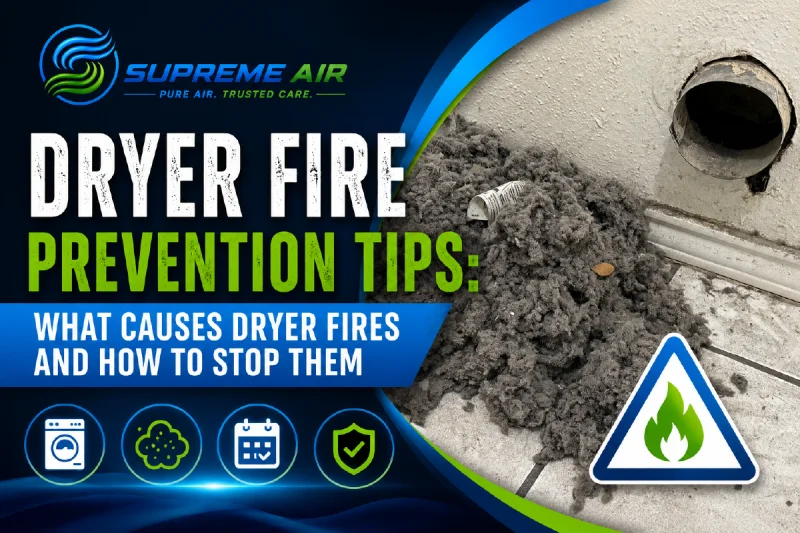

Dryer fires happen more often than most homeowners realize, and the frustrating part is that the overwhelming majority of them are preventable. According to the NFPA, U.S. fire departments respond to tens of thousands of home fires involving clothes dryers and washing machines every year, and the leading factor behind them is not a mechanical defect. It is a failure to clean.
Why Dryer Fires Happen
Every cause below has a straightforward fix, which is exactly what the dryer fire prevention tips later in this guide are built around.
Lint Buildup in the Trap and Vent
This is, by a wide margin, the leading cause of dryer fires. Lint is highly combustible, and every load of laundry produces more of it than the lint trap alone can catch. Some of it escapes past the trap and collects further down the vent line, where it accumulates unseen. Once enough lint builds up around the heating element or restricts airflow enough to trap heat, the conditions for ignition are in place.
Restricted or Crushed Venting
A dryer vent that gets bent sharply, crushed behind furniture, or pinched during installation restricts the airflow the dryer depends on to vent hot, moist air outside. When that airflow is blocked, heat has nowhere to go, and the dryer’s internal temperature climbs well past what it was designed to handle.
Flexible Plastic or Foil Ducting
Rigid metal venting is the standard for a reason. Flexible plastic and foil ducts sag and develop low points where lint settles and accumulates, and unlike rigid metal, they can melt or ignite if they come into direct contact with excessive heat. Most dryer manufacturers explicitly warn against using them in the owner’s manual, yet they remain common in older installations.
Vents That Terminate in the Wrong Place
A dryer vent is supposed to exhaust directly outside. Vents that were installed to terminate in an attic, crawl space, or wall cavity instead of outdoors create a different problem: moisture, heat, and lint all accumulate in an enclosed space, raising both fire risk and the odds of mold growth in that area.
Overloading the Dryer
Packing a dryer beyond its rated capacity restricts airflow inside the drum itself, forcing the motor and heating element to work harder to dry the same load. That extra strain increases both wear and heat, two ingredients that raise fire risk over time.
Oil-Soaked or Chemically Contaminated Fabrics
Towels or rags contaminated with cooking oil, gasoline, or other flammable substances can spontaneously combust after drying, even without direct contact with a heat source, because the oxidation process itself generates heat as the fabric sits. This is one of the least understood causes of dryer fires, since the fire can start well after the dryer has stopped running and the clothes have been removed.
Electrical and Installation Issues
Faulty wiring, a damaged power cord, or an improperly installed strain relief bracket, which is meant to protect the internal wiring from wear as the dryer vibrates during use, can all become an ignition source independent of lint or airflow problems. These are less common than lint-related causes but are worth having checked, especially in an older or recently installed unit.
Warning Signs Your Dryer Vent Needs Attention
A dryer rarely fails without giving some indication first. Watch for:
- Clothes that take noticeably longer to dry than they used to, or require multiple cycles
- The dryer or the clothes themselves feeling hotter than normal to the touch
- A burning or musty smell during or after a cycle
- Visible lint collecting around the dryer, the vent opening, or the exterior vent hood
- The exterior vent flap failing to open properly when the dryer is running
- The dryer shutting off mid-cycle, which can indicate the high-limit safety thermostat is being triggered by excess heat
Any one of these on its own is worth investigating. Several together are a clear signal that airflow somewhere in the system is compromised, and catching these signs early is one of the simplest dryer fire prevention tips there is.
Dryer Fire Prevention Tips That Actually Make a Difference
These are the dryer fire prevention tips that address the causes above directly, rather than treating the dryer as a fire risk to simply tolerate.
- Clean the lint trap before every load, not just when it looks full. A thin film of lint left on the screen still restricts airflow even when it does not look like a problem.
- Have the full vent line professionally cleaned at least once a year. Lint trap cleaning alone does not reach the lint that builds up further down the duct.
- Replace flexible plastic or foil ducting with rigid or semi-rigid metal venting. This single change addresses one of the more preventable fire risks in a dryer setup.
- Never dry fabric that has been in contact with flammable substances. Let those items air dry outdoors instead.
- Do not overload the dryer. Dry large or bulky items, like comforters and rugs, in smaller loads or separately.
- Keep the area around the dryer clear of anything combustible, including boxes, laundry piles, and stored items.
- Never run the dryer unattended overnight or while away from home. Most serious dryer fires happen when no one is present to catch the early warning signs.
- Check that the exterior vent termination is unobstructed, since debris, snow, or even nesting birds can block it from the outside.
- Have gas dryers inspected annually for a secure gas line connection, in addition to standard vent maintenance.
How Professional Dryer Vent Cleaning Helps
A visual check of the lint trap only tells part of the story. The vent line itself, often running through walls, ceilings, or attic space, accumulates lint in sections that are impossible to reach or inspect without the right tools. Professional dryer vent cleaning clears the full length of the vent, not just the accessible portion near the dryer, and includes a check of the exterior termination point to confirm it is open and unobstructed.
This matters because a vent that looks clear at the dryer connection can still be significantly restricted further down the line, particularly in longer vent runs or homes where the dryer sits far from an exterior wall. Outsourcing this one task is one of the most effective dryer fire prevention tips available to homeowners.
What to Do If Your Dryer Catches Fire
If a fire does start, acting quickly and correctly matters more than anything else.
- Get everyone out of the house immediately. This comes before anything else.
- Call 911 once everyone is safely outside.
- If it is safe to do so, unplug the dryer or cut power at the breaker, but never risk personal safety to reach a cord or panel.
- Do not open the dryer door if the fire is contained inside the drum. Opening it introduces oxygen and can cause flames to intensify.
- Do not use water on an electrical fire. Water conducts electricity and can make the situation more dangerous. A dry chemical or Class C fire extinguisher is appropriate if you have one and it is safe to use.
- Leave the fire to professionals if it grows beyond a small, contained flame. No load of laundry is worth the risk of staying in a burning structure.
Frequently Asked Questions
Most fire safety organizations recommend at least once a year for average household use. Homes with heavy laundry use, pets that shed, or a longer vent run between the dryer and the exterior wall may need it more frequently. This is one of the most repeated dryer fire prevention tips for good reason.
No. The lint trap only catches a portion of the lint produced during drying. The rest travels down the vent line, where it accumulates in sections a homeowner cannot see or reach without disassembling ductwork.
Both carry fire risk, though the ignition pathways differ. Gas dryers add a secondary risk around gas line connections, which is why annual professional inspection is particularly important for gas units. According to the USFA, failure to clean remains the single leading factor contributing to dryer fires regardless of fuel type.
Yes. A new dryer connected to old, damaged, or improperly routed venting carries the same fire risk as an older unit. The dryer’s age matters less than the condition of the vent system it is connected to.
Rigid or semi-rigid metal ducting is the safest option. It resists heat far better than flexible plastic or foil venting and is much less likely to sag, kink, or trap lint at low points along its length.
A basic lint trap cleaning is safe for anyone to do after every load. Cleaning the full vent line typically requires moving the dryer, accessing sections of ductwork behind walls or in attics, and using specialized brushes or vacuum equipment, which is why most homeowners have this done professionally rather than attempting it themselves.
If your dryer consistently takes longer than one cycle to dry a normal load, even with a clean lint trap, an overly long or improperly configured vent run is a common culprit. A professional inspection can confirm whether the vent length and number of bends meet manufacturer specifications.
Regular vent maintenance is one of the simplest dryer fire prevention tips available. Supreme Air Austin offers dryer vent cleaning that clears the entire vent line, not just what’s visible. Schedule an inspection or call (512) 277-9782 to have your system checked.